

Mercedes-Benz SLC C107: model overview
The Mercedes-Benz C107, better known as the SLC, is the closed coupé version of the R107 SL. Developed in the 1970s and early 1980s as a luxurious grand tourer, it was designed to combine elegance, performance and long-distance comfort. Thanks to its longer wheelbase and fixed roof, the C107 offers increased interior space and improved comfort, while retaining the smooth driving dynamics and proven reliability Mercedes-Benz is known for.
Today, the earliest C107 models are over 50 years old, and even the final production years date back to the early 1980s. This makes the SLC a true classic in its own right. Yet buying a Mercedes C107 often raises questions. What are the differences between model years? Which engines and versions are available? How does the C107 differ from the R107? And what should you look out for when purchasing a Mercedes SLC?
On this page, you will find detailed and practical information about the Mercedes-Benz SLC, based on real-world expertise. We cover topics such as:
- An overview of generations, versions and engine options
- Key design and technical differences
- The main strengths and weaknesses of each variant
- A realistic estimate of purchase and maintenance costs
- A comparison with the R107 SL (convertible)
- Answers to frequently asked questions about the SLC model
Overview of the generations
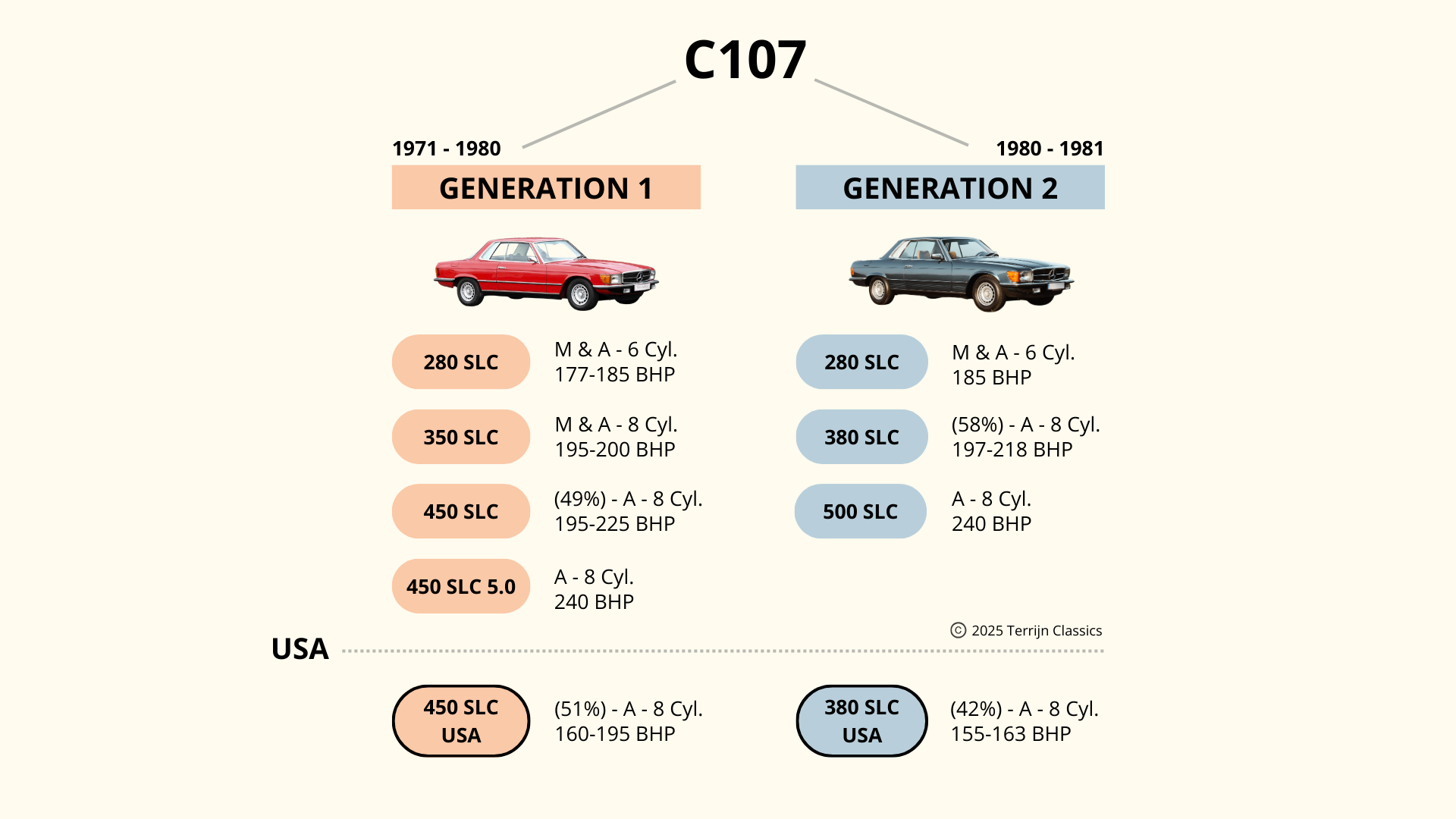
The Mercedes-Benz C107 was produced in two distinct generations, each with its own characteristics and engine options. The overview below clearly presents these generations, showing the different engine variants, from the 280 SLC to the 500 SLC, along with the available transmissions. We also distinguish between European models and U.S. specifications, which each feature their own technical details and regulatory differences.
Particularly noteworthy within the SLC range are the 450 SLC 5.0 and the 500 SLC. Thanks to their rally heritage, these models received special treatment and differ from other SLC variants in several key areas.
M = Manual; A = Automatic; Cyl = Cylinders
BHP = Brake Horsepower: a unit of measurement used to express engine power. It represents the engine’s output before any losses from auxiliary components such as the alternator, water pump, or other drivetrain accessories are deducted.
Key characteristics by generation
Below, you will find the defining characteristics of the C107 models, along with their main strengths and points of attention. We also provide a practical guideline for the expected purchase budget, depending on the vehicle’s condition and level of originality.
Generation 1: (1971 - 1980) 280 SLC, 350 SLC, 450 SLC, 450 SLC 5.0
The Mercedes-Benz C107 SLC was introduced in 1971 as the successor to the W111 Coupé. The leap in design and engineering was significant, marking major progress in driving comfort and performance. The soft, rounded lines of the 1950s and 1960s gave way to a more modern, angular design, while safety became an increasingly important focus.
Like its SL sibling, the SLC underwent continuous development throughout its production run. Most technical components and engine developments remained largely identical across both models. However, the SLC also featured several unique specifications. From 1976 onwards, every C107 came standard with a heated rear window, while rear seat belts became standard equipment from 1979. A particularly durable “Pullman” velour interior was also exclusive to the coupé models.
As with the SL, early SLC models are technically robust and offer a very pleasant driving experience. From our experience as Mercedes-Benz classic car specialists, the difference in driving feel between the first and second generation is less pronounced than in the SL range, despite identical technical evolution. As with the SL roadster, the overall driving experience and enjoyment largely depend on the car’s general condition. The contrast between a well-maintained example and a poorly kept one is substantial.
Strenghts
- Higher production numbers, resulting in a wider choice
- On average slightly lower prices
Weaknesses
- More susceptible to rust
- Higher fuel consumption
(especially pre-1976 models)
Realistic budget to expect*
- Project car or non-runner: €1.000 – €7.000
- Running car in need of major work: €7.000 – €19.000
- Good with room for improvement: €19.000 – €30.000
- Very good to excellent condition: €30.000 – €60.000
(An exceptionally good 450 SLC 5.0 may exceed this range) * Price indication for 2025
Generation 2: (1980 - 1981) 280 SLC, 380 SLC, 500 SLC
The second generation of the Mercedes-Benz SLC was introduced in 1980, alongside the facelift of the SL R107. For the SLC, however, this update proved to be short-lived, as the model was already replaced in August 1981 by its successors: the Mercedes-Benz 380 SEC and 500 SEC. This new S-Class Coupé (Type 126) was available exclusively with V8 engines, underlining its elevated status and exclusivity. Both versions were based on the W126 S-Class saloon, which had already been launched at that time. Due to the rapid arrival of its successor, the SLC — unlike the SL R107 — never received a third generation.
Because of its short production run, the number of facelift SLC models is also limited. Production figures show that only 16% of all SLCs belong to the second generation, making them significantly rarer than first-generation examples. As with the SL, the engines were updated as well. The M116 3.5-litre engine was upgraded and replaced by the more modern 380 variant. The M117 4.5-litre evolved into a 5.0-litre version, which also succeeded the exclusive Mercedes-Benz 450 SLC 5.0. The M110 2.8-litre remained largely unchanged, although it did receive several refinements.
Throughout its production run, the SLC remained a popular and well-regarded model, with only a slight decline towards the end following the announcement of its successor. On today’s classic car market, the model continues to gain popularity year after year, resulting in steadily rising values.
Strenghts
- Lower fuel consumption
- Most reliable engine options
- Significant technical improvements over early models
Weaknesses
- Higher prices
- Harder to find due to short production run
Realistic budget to expect*
- Project car or non-runner: €2.000 – €9.000
- Running car in need of major work: €9.000 – €22.000
- Good with room for improvement: €22.000 – €35.000
- Very good to excellent condition: €35.000 – €70.000
(An exceptionally good 500 SLC may exceed this range) * Price indication for 2025
Overview of key features by generation
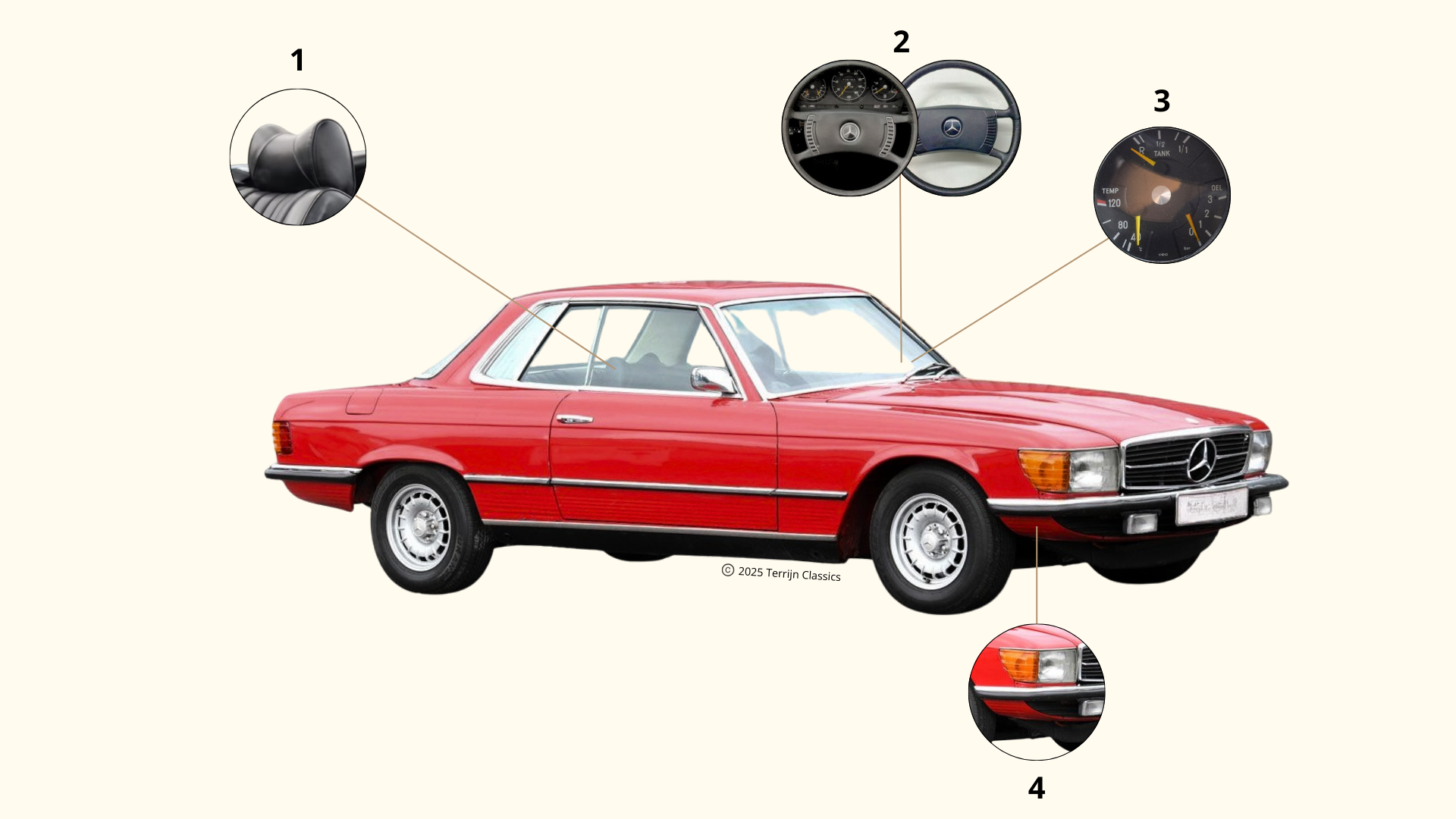
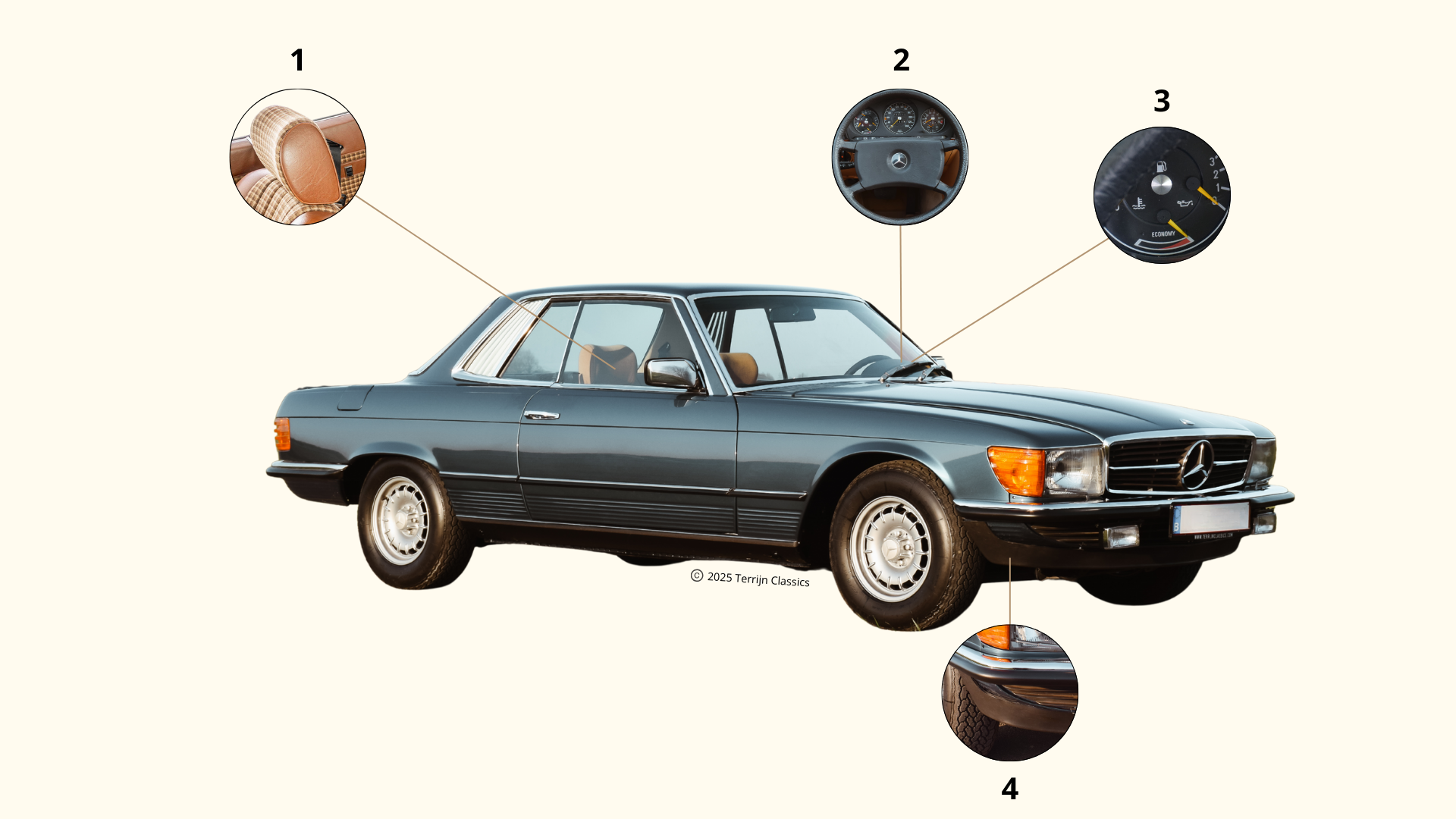
To provide a clear and practical overview, all key features are summarised in the list below. This makes it easy to verify the details when inspecting a car in person.
We regularly encounter SL and SLC models that have been modified over the years, sometimes to enhance appearance or give the car a more modern look. A common example is fitting later alloy “Gullideckel” wheels to an earlier model. In some cases, the changes go further, such as a first-generation 280 being fitted with an engine and transmission from a later generation.
Often, these modifications are harmless. Depending on what has been changed, they do not necessarily detract from the car’s overall condition or mechanical integrity. Such alterations are more commonly found on cars that have experienced periods of less careful ownership. However, more extensive modifications can sometimes lead to technical issues. It is therefore important to remain attentive and inspect each car thoroughly.
How to identify a USA version SLC
In the United States, only two official versions of the C107 were delivered: the 450 SLC and the 380 SLC. Other engine variants carrying U.S. registration are considered part of the so-called “grey market”. These were European-spec models that were imported after delivery, as they were not officially sold in the U.S.
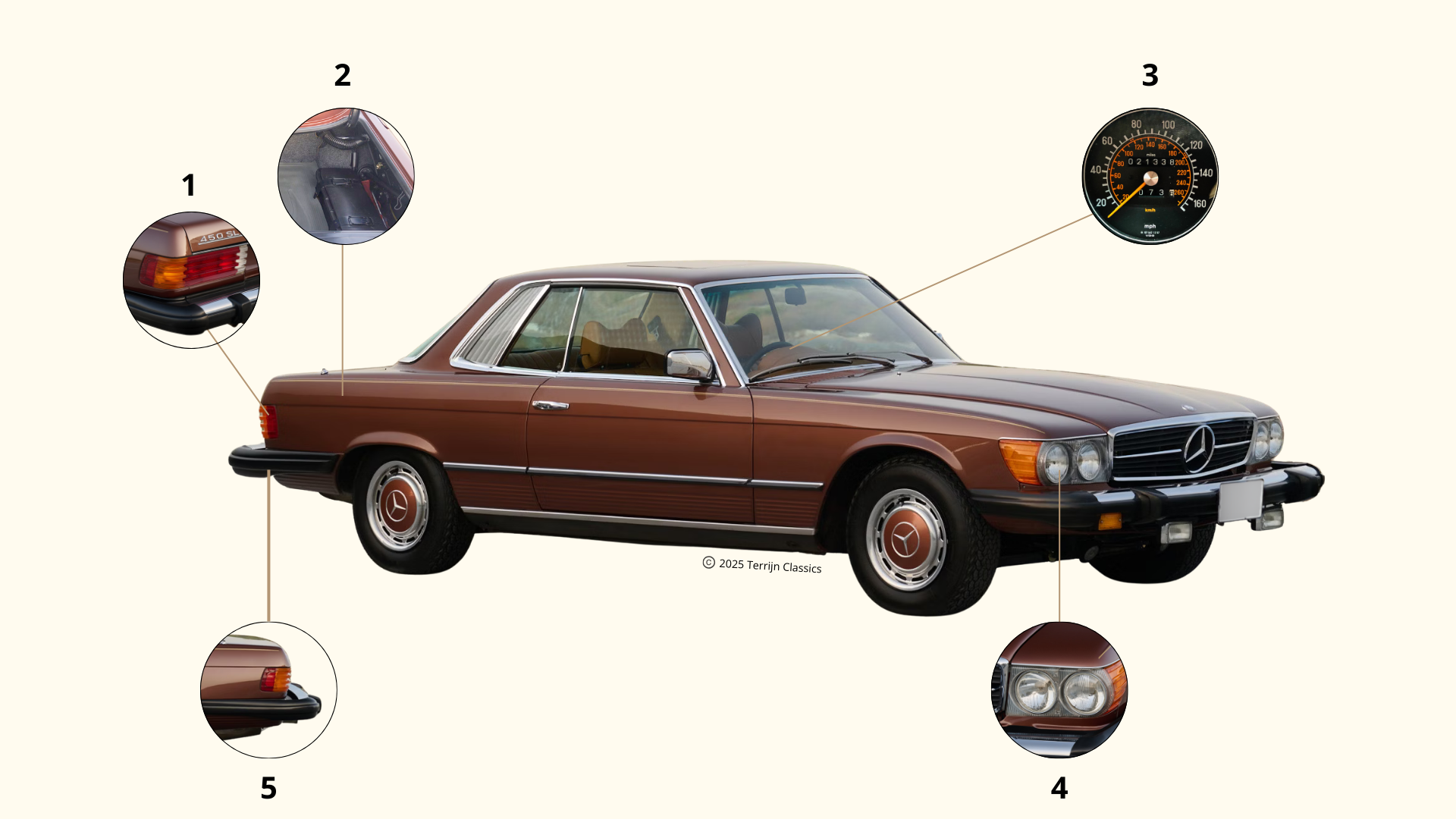
In our workshop, we regularly carry out conversions from U.S.-specification to European specification. This typically involves modifying the bumpers, headlights and instrument cluster. In some cases, the additional third brake light on the boot lid also needs to be removed, although this is less common on SLC models. Such a conversion requires investment, but significantly increases the car’s value when performed to a high professional standard. Certain features, such as the battery location in the boot and the engine number, will always remain identifiable.
The 450 SLC 5.0 and 500 SLC
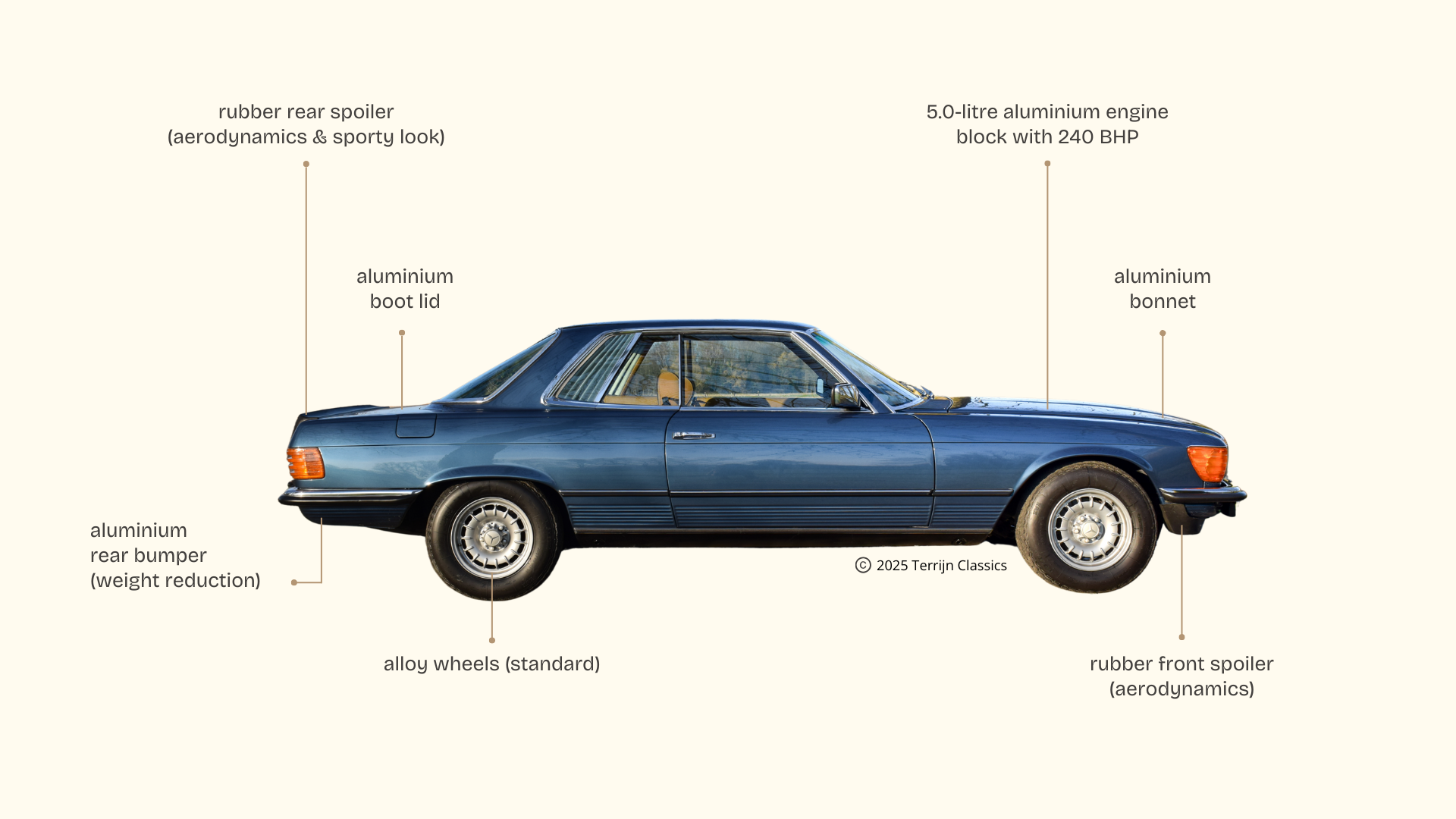
In 1978, the first Mercedes-Benz 450 SLC 5.0 models were produced, later followed by the 500 SLC. These represented a more prestigious and higher-performance version of the model. Thanks to extensive weight-saving measures applied to the bodywork, exterior components and engine, these versions were 115 kg lighter than the standard 450 SLC. The engine also delivered a higher output of 240 BHP, equivalent to approximately 243 horsepower.
The 450 SLC 5.0 featured several technical upgrades that were later adopted across the entire SL and SLC range with the 1980 facelift. For example, the bonnet was already made of aluminium, a feature that became standard on all models from 1980 onwards. The rubber front spoiler beneath the bumper also became standard equipment following the facelift. Alloy wheels were standard on both the Mercedes-Benz 450 SLC 5.0 and the 500 SLC.
Rare & Exclusive
Due to the low production numbers of both versions, these models remain rare Mercedes-Benz classics to this day. Total production amounted to just 1,615 units of the Mercedes-Benz 450 SLC 5.0 and 1,154 units of the Mercedes-Benz 500 SLC. Combined with their successful rally heritage, this makes them the most valuable and sought-after SLC variants on today’s market.
Rally Heritage
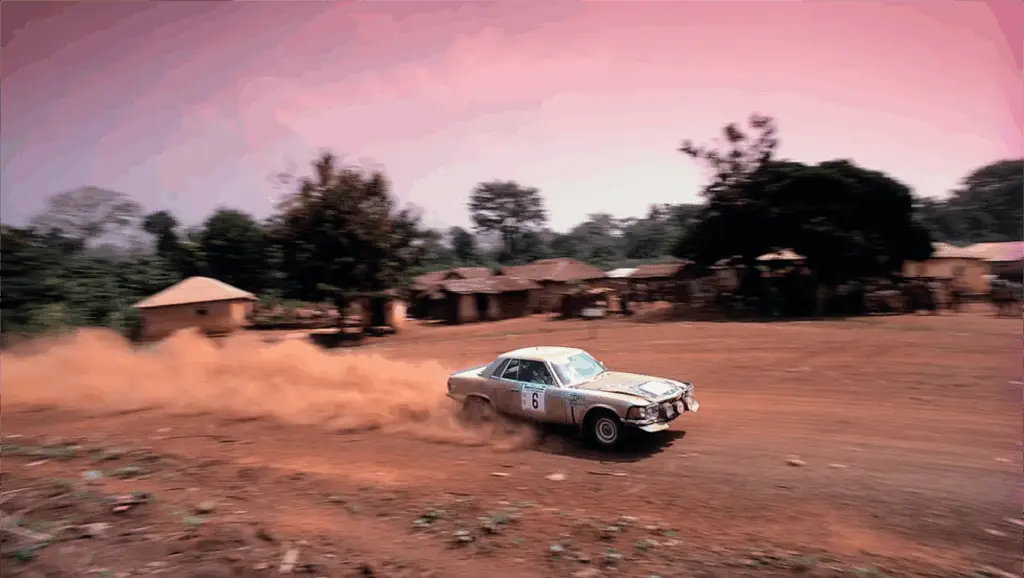
The Mercedes-Benz SLC C107 boasts an impressive rally history. Private owners competed in various rallies with mixed success. In 1978, Mercedes-Benz decided to establish its own factory rally team using this model. The 450 SLC 5.0 was homologated by the FIA in the Group 4 rally class, where it achieved outstanding results. At the 1979 Rallye Bandama in Ivory Coast, the four entered 450 SLC 5.0 cars claimed the first four positions, with the nearest competitor — a Toyota — finishing more than two hours behind.
For the 1981 season, several 500 SLs and 500 SLCs were prepared by Mercedes-Benz. However, senior management ultimately decided to withdraw the factory team from rally competition. Private rally drivers continued to campaign the model in various events thereafter.
Bron: Daimler AG – Mercedes-Benz Classic Communications
The difference compared to the R107 roadster
Within the Mercedes-Benz 107 series, there are two distinct models: the SL (R107) and the SLC (C107). Although they are closely related from a technical standpoint, each was designed for a different type of use, resulting in clear and noticeable differences.
The Mercedes-Benz R107 SL is the two-seat (sometimes 2+2) convertible and represents the direct successor to the W121 190 SL and the W113 Pagoda. It was later succeeded by the R129 SL. The SL is the sporty roadster within the Mercedes-Benz range, offering an excellent balance between dynamic driving, luxury and comfort. Want to learn more? Be sure to explore our detailed R107 model overview.
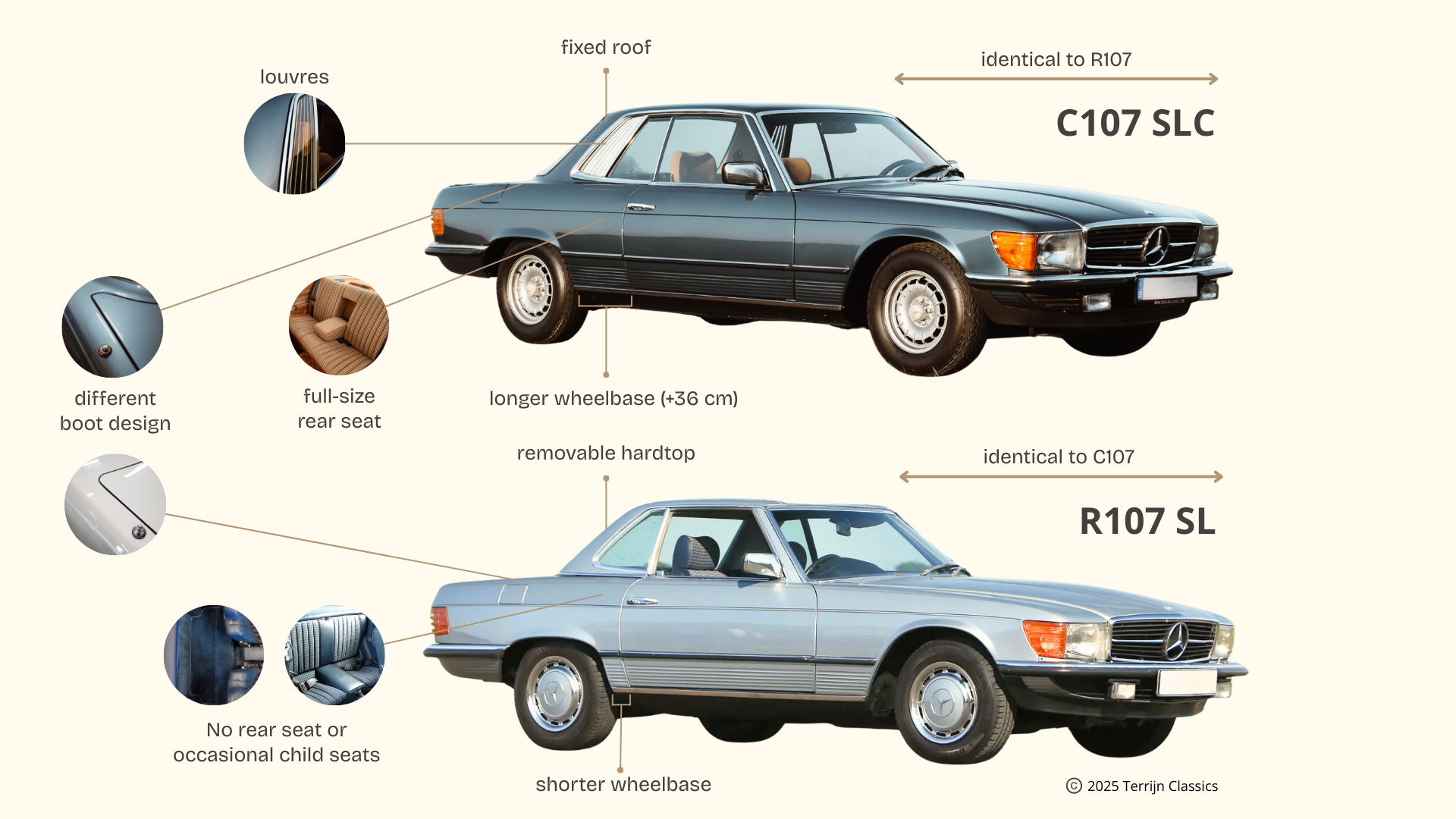
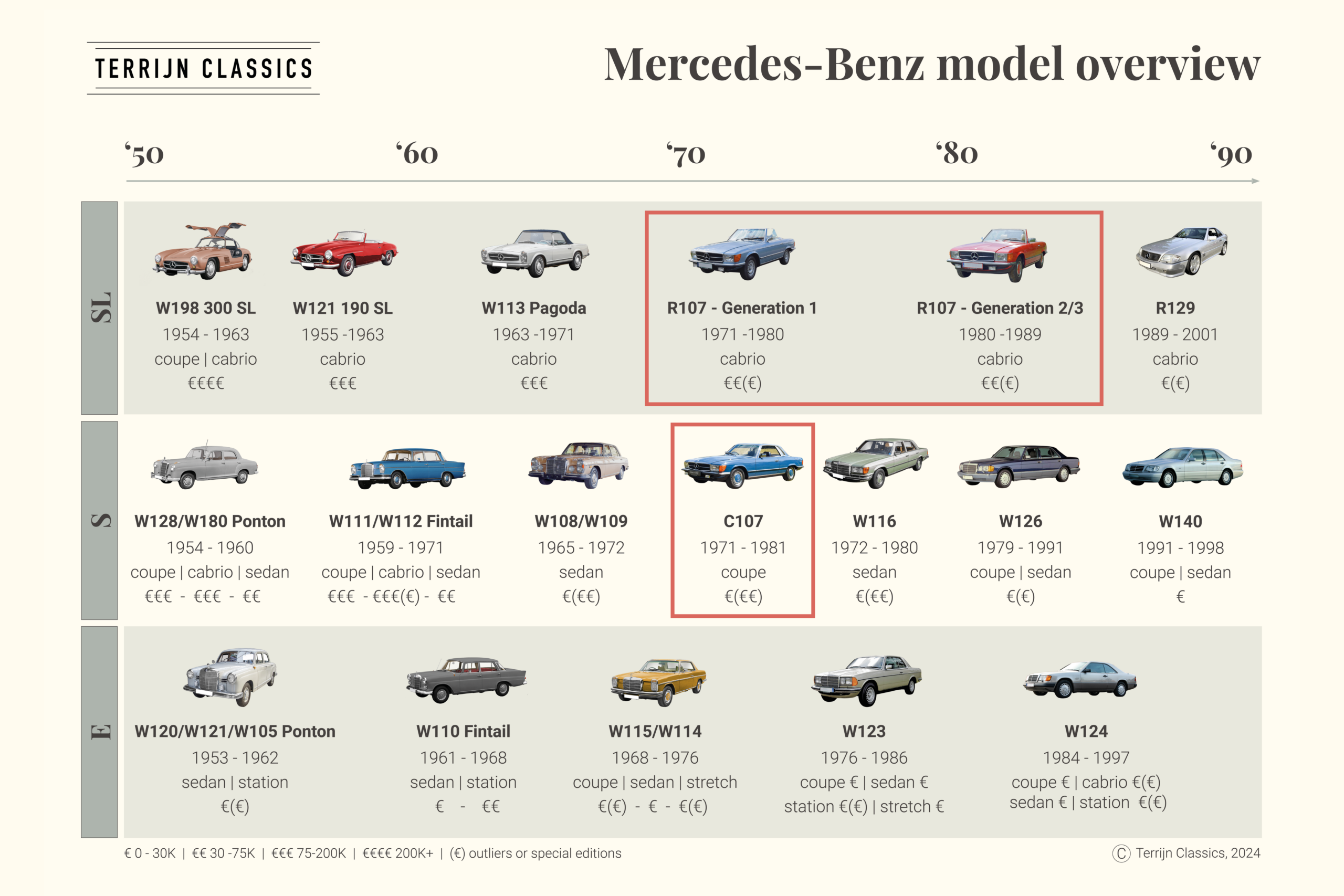
The Mercedes-Benz C107 SLC is the closed coupé version of the R107. With its fixed roof and extended wheelbase, it positions itself as a true four-seater, with comfort and luxury as its main focus. Rather than following the SL lineage, the SLC aligns with the S-Class coupés, with the W111 Coupé as its predecessor and the W126 Coupé as its successor. Within the Mercedes-Benz range at the time, the SLC occupied the very top segment and was, at one point, even the brand’s most expensive model, surpassed only by the W116 450 SEL 6.9. For a broader historical context, we refer to the complete Mercedes-Benz model overview.
The most striking difference between both models is the SLC’s 36 cm longer wheelbase. This additional length allows for a full-size rear seat. The fixed roof not only gives the SLC a distinctive roofline, but also results in a different boot design. Furthermore, SLC models are easily recognized by the characteristic louvres in the rear side windows (click the image to enlarge).
Click here to view the
Mercedes-Benz model overview
Mercedes-Benz C107 – Frequently Asked Questions
When considering a Mercedes-Benz C107, many questions naturally arise. In this section, we answer the most common questions about this model and share practical tips to help you avoid a costly mistake. Still have questions? Feel free to contact us, we’ll be happy to assist you.
Quality Differences. When it comes to the Mercedes-Benz C107, the overall condition of the vehicle is by far the most decisive factor in determining its final value. Buyers looking for a car that is both mechanically sound and visually well-presented are best advised to choose the highest-quality example they can afford. Professional repairs or a full restoration can quickly become very costly. In our workshop, we regularly encounter vehicles where the required repairs exceed the original purchase price. In many cases, owners were tempted by a lower initial price, without fully accounting for the additional costs that inevitably arise afterwards.
Differences between generations and variants. Throughout the production run of the C107, various versions and engine options were introduced, resulting in noticeable value differences on today’s market. Within the C107 range, a clear distinction also exists between European and U.S.-specification models. U.S. versions are generally less sought-after, mainly due to their larger bumpers and lower power output, which translates into lower market values compared to comparable European models. Production numbers also play a significant role: versions built in smaller quantities tend to show stronger long-term appreciation. Scarcity remains a decisive factor in the classic car market and the C107 is no exception.
Which Mercedes-Benz SLC (C107) is the right choice for you largely depends on your expectations. Do you value power and performance above all? Are you looking for a comfortable coupé for long-distance touring? Or do you mainly want to enjoy the timeless character and authentic classic car experience the SLC has to offer?
Your budget and long-term plans also play a decisive role. The various engine options and production years each have their own strengths, and in essence, every SLC can be a reliable classic, provided the car is in good overall condition. That condition remains by far the most important factor. A less sought-after version in excellent condition will ultimately deliver far more driving pleasure and peace of mind than a more popular model with technical shortcomings.
- Make sure you are well informed. As with any major purchase or investment, making a well-considered decision is essential when buying a Mercedes-Benz SLC. Ideally, seek guidance from someone with expertise in classic Mercedes-Benz models, so you fully understand what you are buying and which points deserve special attention. Would you like professional support with your purchase? Read here how we can assist you with our tailored buying advice.
- Allow a realistic budget for repairs. Our experience shows that nearly every C107 on the market suffers, to some degree, from deferred maintenance. Mechanical issues are rarely a coincidence, they are usually the result of postponed servicing. You can find the 7 most common causes of breakdowns in the R/C107 series here. If you spend your entire budget on the purchase price alone, there is a high likelihood that you will face additional, sometimes substantial, costs afterwards. The solution is simple but crucial: always set aside a dedicated budget for mechanical repairs and maintenance at the time of purchase, to avoid unpleasant surprises.
- Buy a C107 that matches your goals. If you are looking for a C107 with very little to criticize, a worn or poorly maintained example is rarely the right choice. A full restoration can quickly exceed the cost of buying a car in healthy condition. If appearance is less important to you, but you primarily want reliable and comfortable driving, it is wiser to allocate more budget to technical servicing and improvements.
As Mercedes 107 specialists, we work with clients who drive their cars daily or weekly, as well as those who only use their classic for longer trips. Others drive exclusively in good weather and aim to keep their car in pristine condition. Every owner has different habits and expectations. The key is to consider your personal goals and preferences carefully when purchasing a Mercedes-Benz classic.
- All-round and versatile
The Mercedes-Benz C107 is a highly versatile classic car, offering the perfect balance between sporty driving and comfortable cruising. This makes it easy and enjoyable to use regularly. Whether for short trips or long-distance journeys, including extended tours to Southern Europe, the C107 delivers effortless comfort and reliability. - Strong value retention over time
Prices of the 107 series continue to rise year after year. Not through extreme fluctuations, but via steady and reliable growth. Based on market data, we observe an average increase of approximately €2,500 per year over the past five years. Despite this upward trend, these models still trade below their long-term market potential, leaving room for further appreciation. - Reliable engineering and outstanding build quality
A mechanically sound C107 is remarkably robust. During this era, Mercedes-Benz adhered to exceptionally high manufacturing standards, resulting in vehicles that remain highly dependable today, provided they have been properly maintained over the years. - High levels of safety
Safety played an important role at Mercedes-Benz from an early stage. Positioned in the upper segment, the C107 was equipped with technology that ranked among the best of its time. Four-wheel disc brakes were standard, ensuring strong braking performance, while ABS became available as an option from 1980 onwards. Many examples also feature electric windows, central locking and air conditioning. Combined with well-engineered crumple zones and a solid safety structure, the C107 remains a safe and confidence-inspiring car in modern traffic.
Anyone considering a Mercedes-Benz SLC should take into account both fixed expenses and costs that strongly depend on usage and technical condition. Thanks to the strong value retention of the 107 series, experience shows that owners who keep their cars for a longer period often recover a large part of their expenses, and in some cases even realize a profit. A clear overview of the costs involved provides a realistic picture of what it financially means to own a Mercedes C107.
FIXED COSTS:
-
Insurance:
- Third-party liability (BA): Between €150,00 and €250,00 per year, depending on your personal profile and insurer.
-
Comprehensive coverage (Omnium): Starting at €500,00 per year, usually ranging up to 1.2% of the insured value. Premiums vary according to policy terms and insurer, and typically become variable from an insured value of €50,000 onwards.
-
Road tax:
- Annual: approx. €105,00 (flat rate, independent of engine size and emissions).
- One-time registration tax: €55 (flat rate, independent of engine size and emissions).
VARIABLE COSTS:
-
Maintenance & Repairs:
-
Very well-maintained examples generally require no more than regular servicing and the replacement of wear components. In such cases, annual costs typically range between €500 and €1.500, depending largely on mileage and usage.
-
Cars showing age-related wear often require additional repairs throughout the year. Here, costs usually range between €500 and €5.000, depending on the technical work required.
-
Deferred maintenance or catch-up repairs are most commonly encountered in recently purchased vehicles or cars that have seen little use over extended periods. These projects can range from several thousand euros to more extensive budgets of up to €30.000, depending on condition and desired level of finish. A carefully considered purchase helps avoid most unpleasant surprises. Be sure to consult our list of the most common purchasing mistakes to minimise risk.
-
Unforeseen repairs, such as engine or transmission work, can have a significant financial impact. We always highlight this possibility in advance, so you are not caught off guard. At the same time, such investments improve the car’s technical quality and, in turn, its long-term value and reliability.
-
-
Fuel consumption:
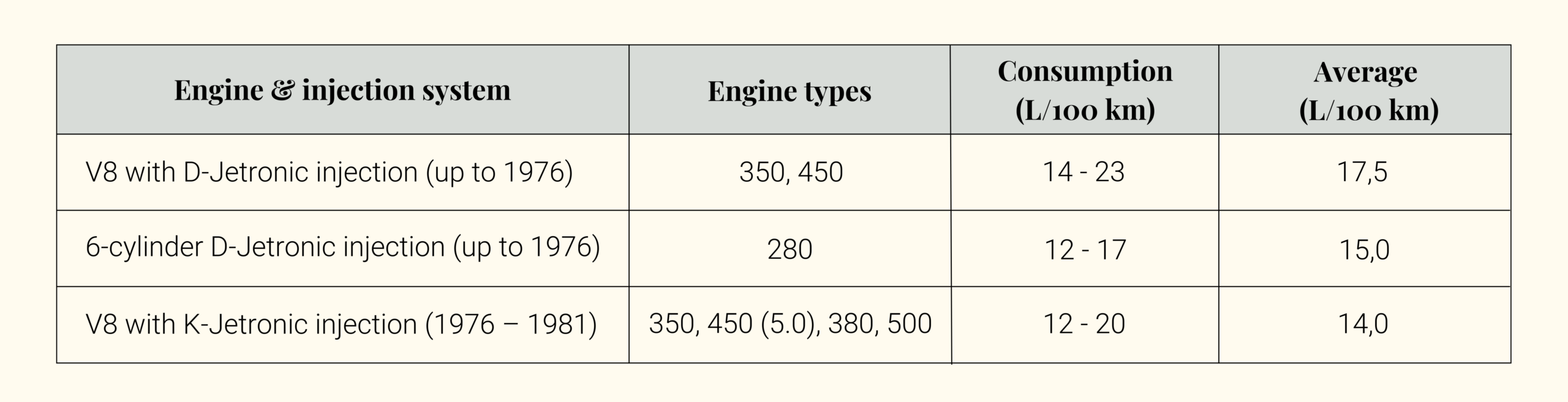
Actual fuel consumption of a Mercedes-Benz C107 mainly depends on engine specification, driving style and type of use. Refer to the table below for real-world examples per engine variant.
-
- Automatic transmissions generally consume slightly more fuel than manual versions.
- With predominantly short trips and city driving, consumption often averages around 20 litres per 100 km. During longer, relaxed journeys, this usually drops to an average of 12 to 13 litres per 100 km.
- Compared to other ownership costs, fuel consumption remains relatively limited in its overall impact for most owners, especially with occasional use. Although the figures may appear high on paper, the actual annual cost is often more modest in practice.
- Automatic transmissions generally consume slightly more fuel than manual versions.
The Mercedes-Benz C107 SLC is a reliable and user-friendly classic. It offers enough modern comfort to handle longer journeys and regular use, without losing the distinctive character of a true classic car. This balance is precisely what makes the C107 such an accessible and appealing classic for many enthusiasts.
When technically sound, an SLC is perfectly suited for extended trips and long-distance road journeys covering several thousand kilometres. The key condition is that maintenance and repairs are addressed preventively. By paying timely attention to known weak points, you significantly reduce the risk of technical issues on the road and preserve driving enjoyment. The most common technical issues we encounter in practice as 107 specialists are clearly outlined here: Mercedes 107 problems.
To support owners in this process, Terrijn Classics has developed a comprehensive Health Check, which systematically and preventively inspects all critical systems of the vehicle. More details can be found on our dedicated Health Check page.
For most classic Mercedes-Benz models, spare parts remain readily available. Consumable parts are generally available new in good quality, either directly through Mercedes-Benz or via reliable aftermarket suppliers. When these options are not available, suitable alternatives can often be found within the broader aftermarket. These are only considered when no higher-quality solution exists. Parts that are no longer produced new can, in many cases, still be sourced second-hand in good condition.
The classic Mercedes-Benz parts market is sufficiently large to ensure a stable and extensive supply. As these vehicles belong to the higher market segment, it also remains worthwhile for manufacturers to invest in high-quality reproductions and components. With the right expertise, sourcing reliable and suitable parts remains both practical and dependable.
As a specialised Mercedes-Benz classic car company, we have in-depth knowledge of the parts market. Depending on the application and objectives, we deliberately choose between original Mercedes-Benz parts (OEM), high-quality aftermarket solutions and, where necessary, carefully selected second-hand components.
